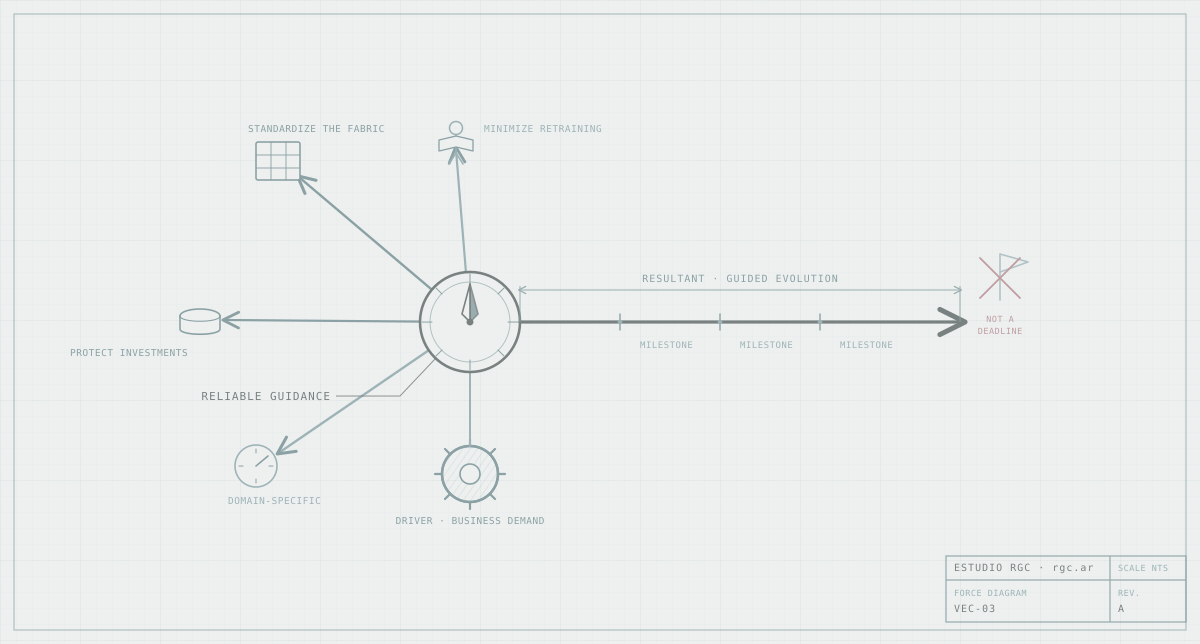
It pays to change the mental picture. The modernization of an application estate is not a project with a cutoff date. It is guided evolution, and what makes it manageable is not a destination but a strategy. A strategy is what lets you hold several needs in tension at the same time without resolving them one at a time and against the rest.
Modernization is not a final event: it is a process with tangible deliverables that carry value.
The tensions are concrete, and they start with what the business asks for: to raise and speed up productivity, and to bring in the new. That is the engine; without that demand there is nothing to modernize. Against that push, four needs have to be held at once. There is a need to standardize across the whole estate, because an ecosystem where every piece speaks its own language cannot be governed. At the same time there is a need to keep each domain's specific data and applications relevant, because that specificity is where the operational value lives and flattening it means losing it. There is a need to protect the investments already made in the existing systems, because discarding them on principle burns money and knowledge. And there is a need to minimize staff retraining, because the people who run the operation cannot stop to study every time a tool changes.
None of these needs wins over the others. The strategy does not pick one. It keeps them in balance, and defines, case by case, where to give on one side to gain on the other. That is Reliable Guidance: not a single recipe, but a stable criterion for deciding well when the needs pull in different directions.
With that picture, the question stops being which platform to buy. The next piece starts the engine: wanting the change and bringing in the new, deliberately.