Series · Modernizing an application estate · Part 4 of 7
architecture · innovation · operations · data
The push: bringing the change, deliberately
Evolution does not start on its own. It begins when someone decides to bring in the new that moves productivity, deliberately, on top of the common tissue.
Estudio RGC · 3 min
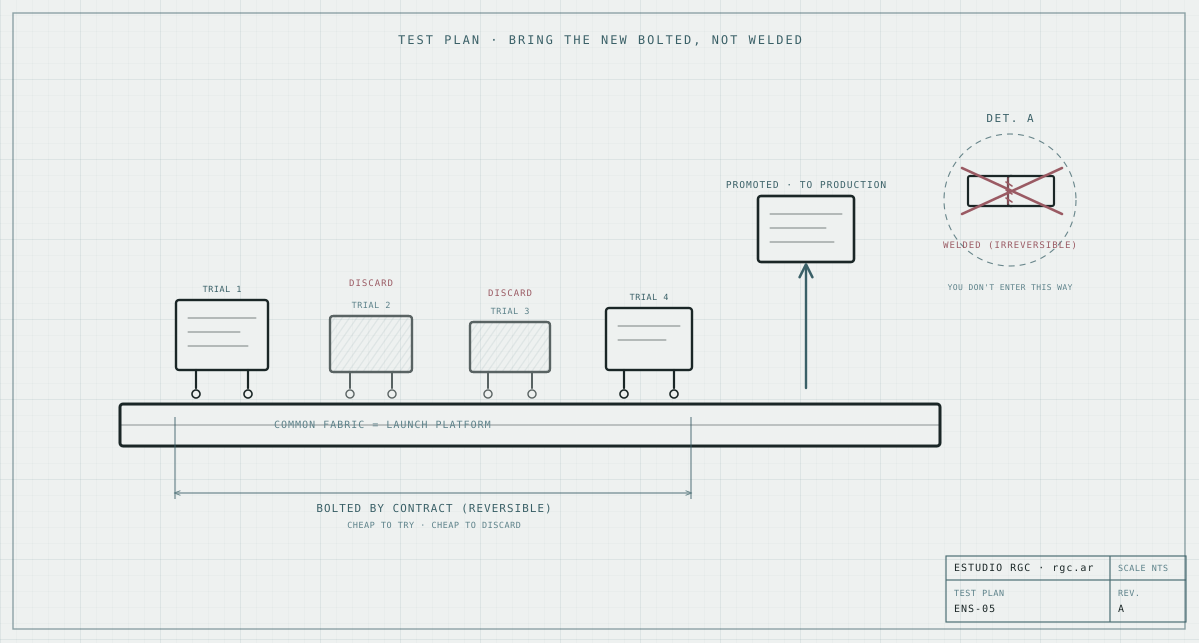
The push comes first: evolution starts from wanting the change, and standardizing enables it, but innovation does not happen on its own, you have to decide it. The common tissue (interfaces, identity, data contracts, observability) is not a cage, it is the launch pad. It lowers the cost and the risk of trying new technology that moves productivity (automation, modern analytics, artificial intelligence, field and mobile tools), because the new comes in tied by contract, not welded on. But the tissue adopts nothing on its own. Innovation is intentional: the strategy has to reserve room for the new, fund the early wins and give it a clear path. Leadership decides that, not chance. A modernization that only tends to the old, and takes for granted that innovation will appear on its own, adopts nothing. With AI the link is direct: a traceable tissue tied by contracts is what makes it trustworthy enough to let into the operation. But someone has to decide to let it in.
And deciding it well means accepting that the risk of failing is high. Innovating with intent is not betting everything on one new tool; it is placing several small, cheap and reversible bets, expecting that many will not work, and being ready to drop the one that does not pay off without drama. The common tissue is what makes that game cheap. Because the new comes in modular and tied by contract, trying costs little and discarding costs little, so the whole operation is never put at risk over a single new thing. That also keeps the alternatives open: it pays to always have more than one path and not end up hostage to a vendor. Modularity is not a technical luxury, it is what lets you be wrong often and cheaply, which is the only real way to innovate.
The push alone is not enough: bringing in the new can break what already runs. The next piece brings the three continuity balances that prevent it.
Glossary
Application estate
The set of systems, platforms and spreadsheets that an operation has built up over the years, with all the integrations in between.
Connective tissue
What ties the applications to one another. Interfaces, user identity, data contracts and observability.
Data contract
The explicit agreement on what data is exchanged between two systems, in what format and with what meaning, so that one can change without breaking the other.
Adapting a system
Giving a legacy system a modern interface on the outside and integrating it into the common flow, instead of replacing it.
Traceability
Being able to follow a piece of data from its origin to the decision that used it.
Accountability
Every number having an owner and an origin, and decisions being defensible.
Multidimensional information
Information that combines several dimensions at once (assets, plants, time, cost, personnel, availability, return) so it can be analyzed from different angles.
The change implementation that drives your operation.