Faced with an accumulated application estate, almost every technical team reacts with one of two instincts. Both are understandable. Both fail.
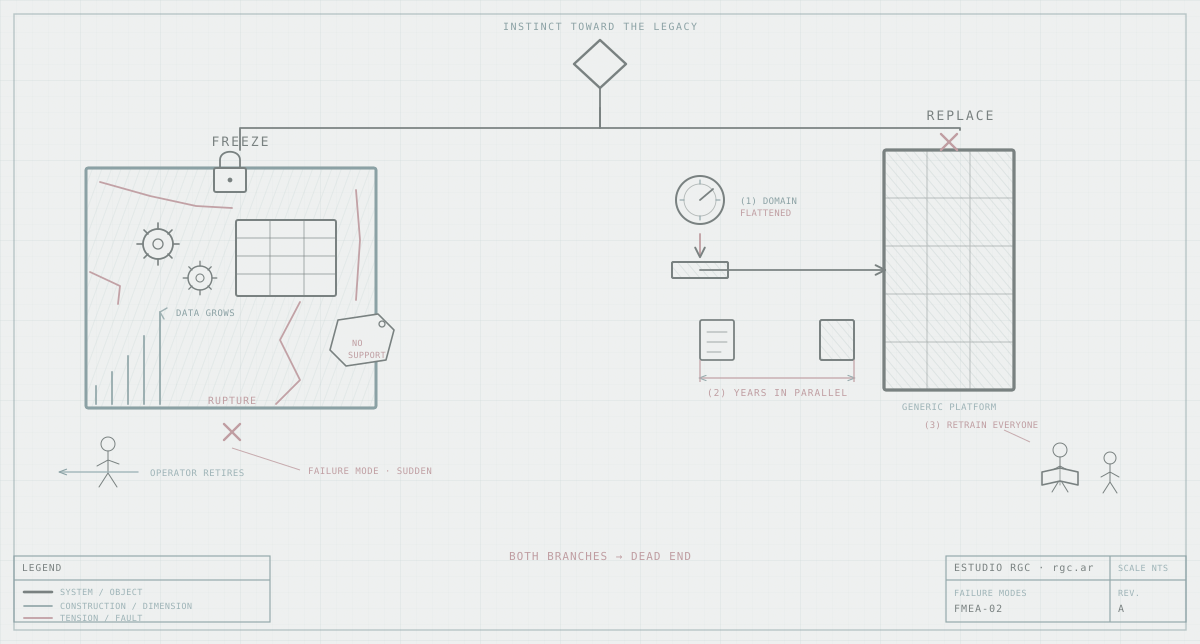
The first instinct is to freeze. The logic is sensible: if it works, do not touch it. The cost of a change done badly on a system that holds production up is high and visible, so the call is to move nothing that is not broken. The problem is that freezing is not free. The operation keeps changing even if the software does not. The data that used to be enough is no longer enough. The vendor stops supporting a version. The person who understood the spreadsheet retires. Freezing does not avoid risk, it accumulates it. One day the system nobody touched fails, and it fails with no one left who knows how it was put together.
The second instinct is the opposite: throw everything out and replace it with a single platform that promises to unify the whole estate. The promise is clean. One tool, one vendor, one place to look. In practice, wholesale replacement runs into three realities. The first is that the generic platform flattens what had value: the specific logic of an unconventional completions process or a field data flow does not fit well into a mold built for everyone. The second is that the migration takes years, and during those years the operation has to live with two systems in parallel, which was exactly the problem it was trying to avoid. The third is that all the staff have to relearn how to work at the same time, and the operation does not stop for that to happen.
The two instincts share the same underlying mistake. Both treat modernization as an event with an end: you freeze and you are done, or you replace and you are done. The modernization of an estate has no such end. If it is neither freezing nor throwing everything out, then what is it. The next piece changes the mental picture: modernizing is evolution with purpose.