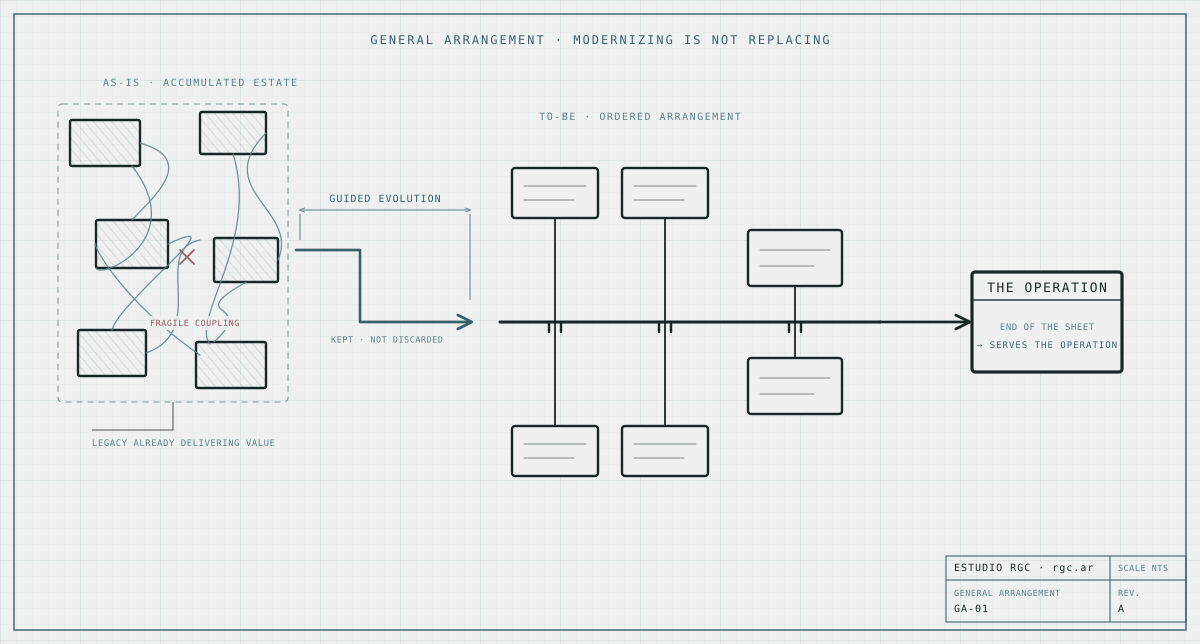
Modernizing an application estate is, above all, evolution with purpose. It is not a replacement you run once and finish, nor something that happens on its own if you buy the right tool. It is deciding what to change and why, bringing in the new deliberately, and guiding it until it lands as an operation. That is Reliable Guidance in one sentence: change is not left to chance, it is steered. That is where change becomes operation.
It pays to see first where you start from. In any operation with a few years behind it, the software did not arrive all at once. It arrived in layers. A drilling system bought for a one-off project. A spreadsheet someone put together to close the daily report that, fifteen years later, is still the source of truth for a critical process. An ERP implemented when the company was half its current size. Each piece solved a real problem at the time. None was designed with the ones that came later in mind. The result is a heterogeneous estate, accumulated, that works and holds the operation up every day, but has become hard to change, to audit and to explain.
Against that, evolution with purpose has three parts. You decide what to change and why, instead of letting the estate keep growing by accumulation. You bring in the new deliberately, because innovation does not appear on its own: you have to go looking for it. And you accept that the risk of failing is high, so you bet small and reversible, drop what does not work and always keep an alternative. None of this happens by inertia. This series builds the conceptual foundation, element by element. We start with the two most common instincts, and both fail: freezing the estate and replacing it wholesale.