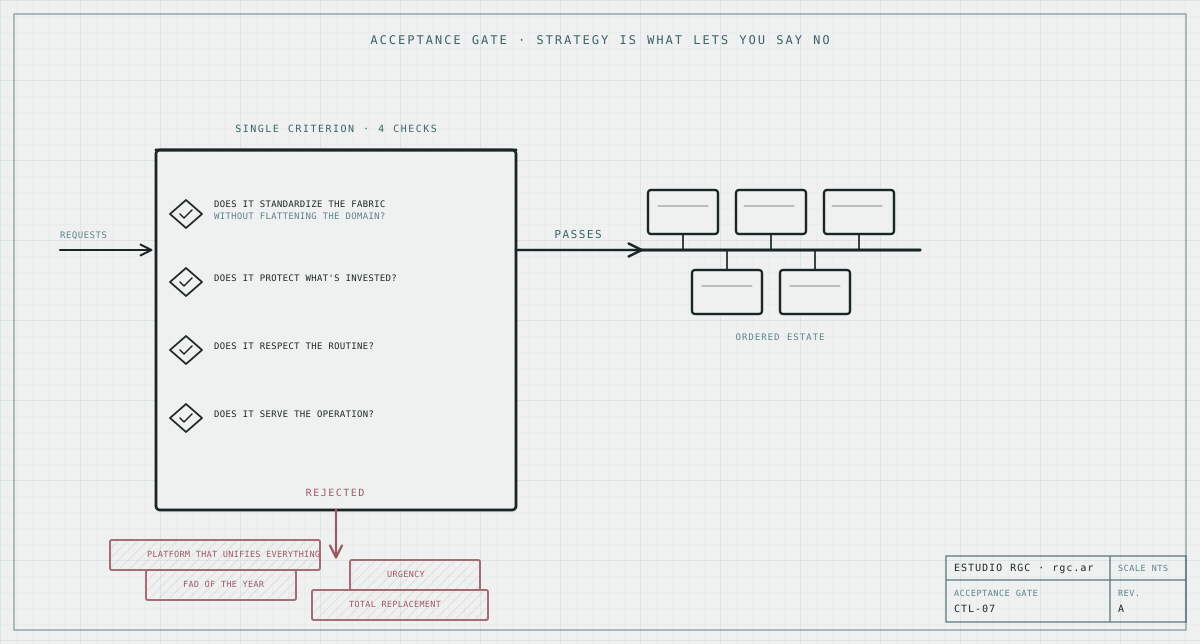
In the end, what is the point of having a strategy. It serves to be able to say no coherently. Without a strategy, every new request, every platform that promises to unify everything, every urgency, is evaluated on its own, and the answer ends up depending on who pushed hardest that week. The estate grows by accumulation, which is exactly how the problem was reached in the first place.
With a strategy, every decision is measured against the same criterion: does this standardize the connective tissue without flattening the domain, protect what was invested, respect the routine people already know, and serve the operation? What does not pass that test can be rejected without guilt and without a hallway argument. That is what having guidance means.
This series laid the groundwork. In the next series we come down to the ground with the two strategies that coexist over the same estate, each with a partial solution, and with the first concrete pattern: how a legacy system is adapted without stopping the shift.