You cannot modernize what you have not mapped, and you do not fund what does not show value soon.
This note is part of the series Two strategies over the same estate. The guiding strategy, the one that combines what is true in both, is not a slogan: it is a way of sequencing the work. It starts with two disciplines.
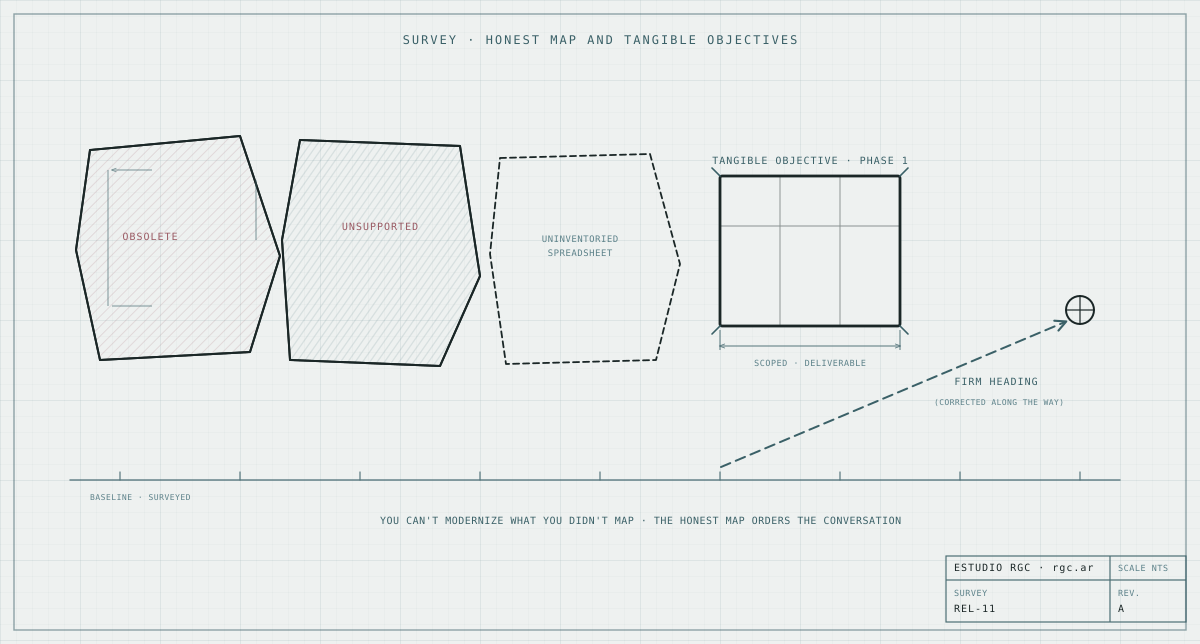
Tangible objectives that fund the rest. A modernization that does not show visible value in the first months loses the permission to continue. That is why it pays to start with a narrow, high-pain flow, deliver something people see and use, and win with that the trust and the budget for what comes next. It is the concrete answer to the skeptic who has already seen big projects promise everything and deliver nothing for two years.
The discipline is in not lying to yourself. The tangible objective is a first step, not the whole campaign. The classic mistake is to celebrate the first dashboard as if the problem were solved and leave the rest of the estate the same as before. The tangible objective is worth what it enables, not by itself: it earns the right to continue, and that right has to be used.
An honest AS-IS and a concrete TO-BE. You cannot modernize what you have not mapped. Before deciding anything you have to know the real estate, and real includes the uncomfortable: what is obsolete, what version lost support, what critical process depends on a spreadsheet that appears in no inventory, what internal application holds a flow up without anyone maintaining it.
That honest map is what orders the conversation between the two strategies. It keeps the sweep strategy from underestimating what there is, because it shows the domain depth buried in the systems it wants to throw out. And it keeps the continuity strategy from hiding what no longer holds up, because it puts obsolescence in plain view.
In parallel you have to define a concrete destination, a TO-BE that can be drawn and debated, accepting from the start that this destination will evolve. You do not aim at a fixed snapshot. You aim at a firm direction with the freedom to correct the heading. A map of the starting point and a clear direction are the minimum to avoid modernizing blind, and enough to start. With the map in hand, the question that scares the skeptic most remains: how to modernize without ending up tied to a single vendor. The answer, and the plug analogy, in the next note.
Glossary
- System of record
- The official, auditable source of a piece of data: accounting, assets, contracts. It needs rigor, immutability and traceability, and can afford to be slower because its value is that no one can dispute it afterward.
- Operational data stream
- The data flow that is born in the field and has to move at the speed of the operation: reports, sensor readings, progress, crew events. It is useful even when incomplete and is corrected downstream; demanding record-level rigor of it suffocates it.
- Data contract
- Explicit agreement at the interface between two systems on the data schema, the meaning of each field, and the quality and frequency guarantees. It decouples producer from consumer, so each can evolve internally without breaking the other.
- Fit-for-purpose governance (by consequence)
- A governance model that classifies data by how it is used and by the consequence of it being wrong, and applies rigor in proportion to that consequence. It avoids both the lack of control where the decision is grave and the pointless ritual where it is not.
- Quality at the source
- Validating the data where it is born, with simple rules and immediate feedback to whoever enters it. It costs far less than rebuilding quality downstream and is the cheapest way to keep an error from propagating.
- Progressive rigor
- A governance strategy that starts light, with visibility and contracts over the few highest-consequence flows, and adds control where the consequence justifies it. It is the opposite of a total program that tries to govern everything at once and never finishes.
- Vendor lock-in
- A situation in which the operation ends up tied to the roadmap, prices and timelines of a single vendor or platform, because it bet everything on it. Standardizing the connective tissue instead of the application is what preserves optionality and avoids being held hostage.
- Connective tissue
- The set of connections through which the pieces of the ecosystem talk to each other: interfaces, identity, data contracts, observability. Standardizing the connective tissue, and not the application, is what lets you change any piece without redoing the whole.
- AS-IS (current state)
- The honest map of how the application estate stands today: what exists, what is obsolete, what depends on what. The real starting point, unretouched.
- TO-BE (target state)
- The direction the ecosystem is meant to be taken in, drawable and debatable, corrected as you go. Not a fixed snapshot, but a firm heading.