This note is part of the series Two strategies over the same estate, and it closes it. In the previous note we separated the record from the stream and left each domain owning its data. Here is the second half, and with it the point of all the governance.
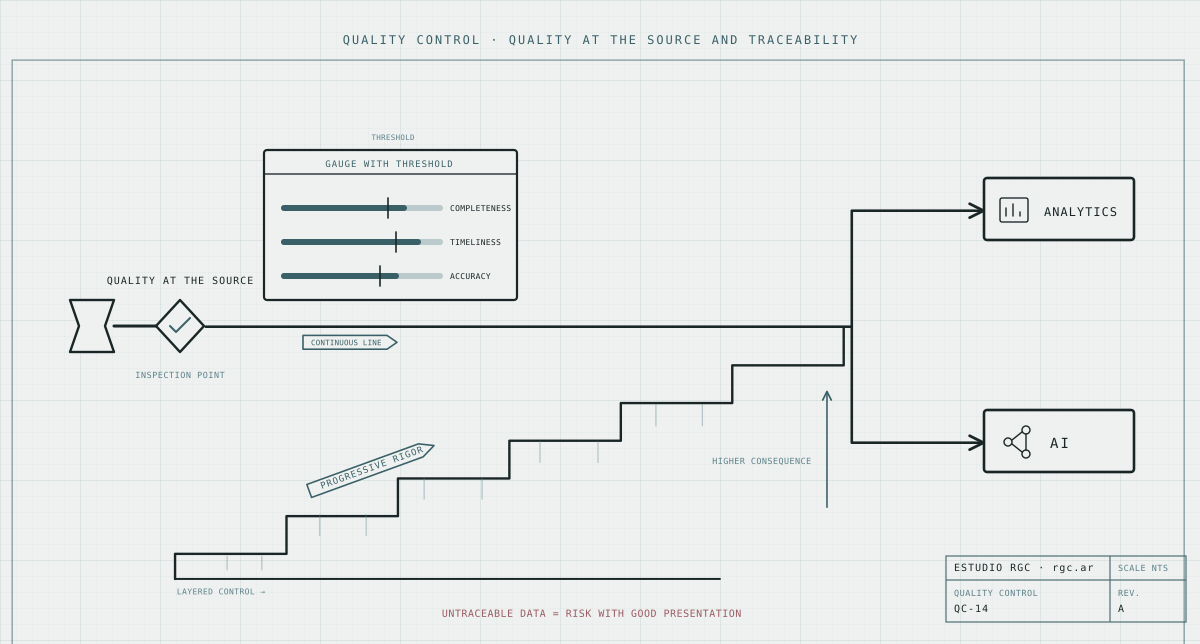
Quality at the source, and measurable where it matters. Data is best fixed where it is born. Validating at the source, with simple rules and immediate feedback to whoever enters it, costs far less than rebuilding quality downstream. And where the data feeds a decision that matters, quality has to be visible and measurable: completeness, timeliness, accuracy, with an explicit threshold and a clear remediation path when it falls below. The rule is a single one: quality proportional to the decision that data feeds. Neither less where the decision is grave, nor a quality ritual where the decision does not call for it.
Progressive rigor, instead of solving everything at once. You do not start with a total governance program over all data, because that program never finishes and shows no value. You start light: visibility and contracts over the few highest-consequence flows. Then you add rigor where the consequence justifies it, measured and in plain view. Governance grows the way the estate grew, in layers, but this time guided by a criterion instead of by the week's urgency.
Traceability, for analytics and for AI. There is a purpose that orders all these pieces. Governance has to serve visibility, traceability, accountability, agility, and the secure, and when needed confidential and controlled, delivery of multidimensional information to two consumers at once: the classic analysis of always and analysis based on artificial intelligence. Both need the same thing underneath: data with context, with clear permissions, and with an origin that can be followed. A piece of data that cannot be traced is not an asset, it is a risk with good packaging. An AI model built on data no one can audit inherits that risk and amplifies it.
The close of the series. In the end, what all this is for. It serves to be able to say no to both extremes with the same criterion. No to taking the continuity strategy all the way to freezing everything, because freezing accumulates risk until it blows up. No to taking the sweep strategy all the way to replacing everything, because that flattens the domain and makes you hostage to a vendor. No to the governance that imposes on the flow the cadence of the accounting ledger, because it chokes the operation it claims to protect. The two strategies each have half the truth, and the operation needs both halves. The guiding strategy does not pick one of the two: it combines what is true in each and rejects the extreme of both. That is guided evolution, and that is what it means to have reliable guidance. In the next series we come down from the criterion to the ground: we take a single critical flow and show, step by step, how a data contract and a quality dashboard are put on it without stopping the shift.